

For most of its history, writing SQL has been a largely manual craft. A database administrator or developer would pull up a query editor, recall the relevant table names and column definitions from memory or (more likely!) a schema diagram, and construct statements piece by piece. Syntax errors were caught at execution time. Optimization was a separate, deliberate step. Now, AI-powered code completion is beginning to change that workflow in meaningful ways - not by replacing the human (at least, not yet!), but by compressing the distance between intent and working query.
What AI Code Completion Actually Does
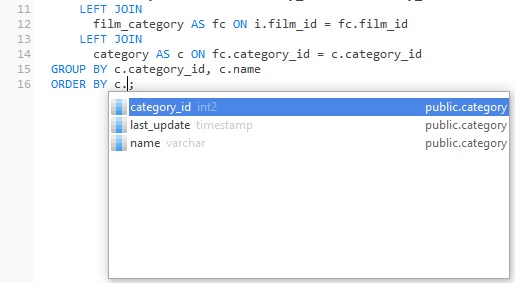
Traditional code completion, i.e., the kind that has been in database IDEs for years, works by pattern-matching against known SQL syntax and object names in the connected schema. It can suggest a table name after you type FROM, or complete a column name once it recognizes the context. Useful, but fundamentally mechanical.
AI-powered completion goes further. Rather than just predicting the next token based on syntax rules, it understands intent. You can describe what you want in plain language, for example, "find all customers who placed more than three orders in the last 90 days", and the AI can generate a complete, structurally sound SQL statement. It can also suggest how to rewrite a subquery as a JOIN, flag a missing index condition, or explain why a particular query might perform poorly at scale. The difference is less about autocomplete and more about having a knowledgeable collaborator available at the point of writing.
The Practical Impact on DBA Workflows
The most immediate benefit of AI-powered completion is speed. Routine queries such as aggregations, filtered selects, and common JOIN patterns that would take a few minutes to write carefully can often be scaffolded in seconds, leaving the DBA to focus on reviewing and refining rather than constructing from scratch. For less experienced team members, this is particularly valuable: AI suggestions provide a working starting point and implicitly model good query structure, which accelerates learning in a way that blank-editor writing does not.
There are also gains in consistency. When multiple developers are working across the same schema, AI tools can help enforce consistent patterns for things like date filtering, NULL handling, and aggregation logic, hence reducing the subtle variability that tends to creep into large SQL codebases over time.
That said, AI-generated SQL still requires careful human review. The output is only as good as the context provided, and models can confidently produce queries that are syntactically valid but semantically wrong - joining on the wrong key, filtering on the wrong column, or missing a critical business rule that the AI had no way of knowing. The DBA's judgment remains indispensable; AI assistance changes where that judgment is applied, not whether it's needed.
AI Features in Navicat On-Prem Server 3.1
Navicat On-Prem Server 3.1, released in February 2026, brought AI Assistant and Ask AI into the on-premise collaboration platform for the first time - making these capabilities available to teams who manage their database infrastructure entirely within their own network.
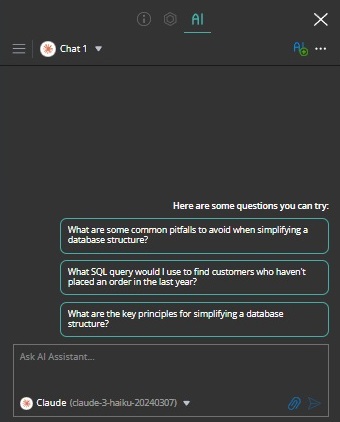
The AI Assistant provides a conversational interface directly within the platform where users can ask questions and receive immediate answers. This is particularly useful for query writing and explanation tasks: a team member can describe what they're trying to retrieve, ask the assistant to explain an unfamiliar query written by a colleague, or get guidance on SQL syntax without leaving the tool they're already working in.
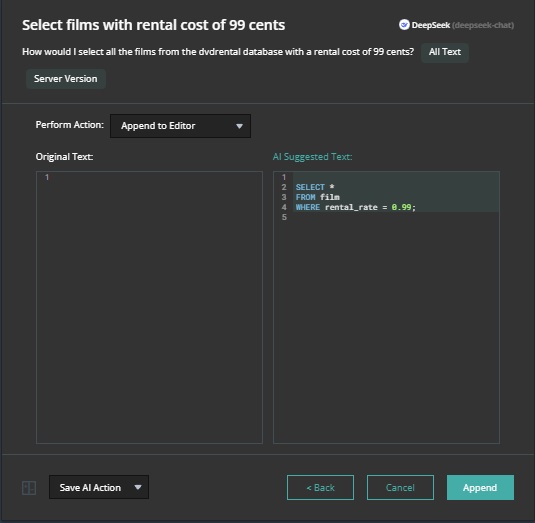
Ask AI is oriented more toward specific, action-driven tasks in the query editor. Users can invoke it to explain, optimize, format, or convert SQL queries, covering some of the most common tasks that slow down query development. Frequently used actions can be pinned for quick access, which makes the feature practical for day-to-day use rather than something you have to dig for when you need it.
Conclusion
AI code completion isn't replacing the DBA, it's changing the shape of the job. The cognitive load shifts away from syntax recall and boilerplate construction toward higher-order tasks: validating AI output, making architectural decisions, and applying the business context that no model can infer on its own. For teams willing to adapt their workflows thoughtfully, these tools represent a genuine productivity gain. The challenge, as with most AI tooling, is learning where to trust the output and where to intervene - and that judgment, for now, remains entirely human.